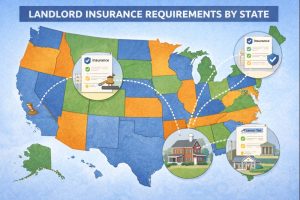
Introduction
Understanding landlord insurance requirements is essential for anyone who owns rental property in the United States. While landlord insurance is not always explicitly mandated by state law, it is often required by mortgage lenders, local regulations, and risk management best practices.
This article explains landlord insurance requirements by state, clarifies when coverage is legally or contractually required, and helps property owners remain compliant while protecting their financial interests.
Is Landlord Insurance Legally Required in the U.S.?
In most states, landlord insurance is not explicitly required by statute. However, this does not mean landlords can safely operate without it.
Key Legal Reality
-
States regulate minimum liability standards, not specific landlord policies
-
Courts often assume landlords carry appropriate insurance
-
Failure to insure can significantly increase legal exposure
In practice, landlord insurance is considered a de facto requirement.
Landlord Insurance Requirements by State
Landlord insurance requirements vary based on state laws, lending rules, and local ordinances.
Common State-Level Expectations
-
Minimum liability standards aligned with negligence law
-
Habitability and premises safety obligations
-
Proof of insurance in certain high-risk jurisdictions
Although states rarely mandate a specific policy, landlords are still held financially responsible for tenant injuries or property damage.
States with Heightened Compliance Expectations
Some states are known for stricter landlord liability environments.
Examples:
-
California – High litigation risk; liability coverage strongly recommended
-
New York – Multi-family buildings often require higher coverage limits
-
Florida – Hurricane risk increases property coverage expectations
-
Texas – Lender-driven insurance requirements are common
In these states, operating without landlord insurance significantly increases financial risk.
Mortgage and Lender Insurance Requirements
The most common mandatory requirement comes from mortgage lenders.
Typical Lender Requirements
-
Proof of landlord insurance for rental properties
-
Dwelling coverage equal to replacement cost
-
Named mortgagee on the policy
Homeowners insurance is usually not acceptable once a property is tenant-occupied.
Local Ordinances and Municipal Rules
Some cities and counties impose additional requirements.
Examples
-
Mandatory liability coverage for registered rental properties
-
Proof of insurance for rental licenses
-
Higher coverage limits for multi-unit buildings
Landlords should always check local housing authority rules.
What Coverage Is Typically Required?
Even when not legally mandated, most compliance standards expect the following:
Required or Expected Coverages
-
Dwelling coverage (replacement cost)
-
Landlord liability insurance
-
Loss of rental income (often lender-required)
Failing to carry these coverages may result in lease disputes or denied claims.
Liability Coverage and Legal Exposure
Landlord liability insurance is often the most critical requirement.
Common Liability Claims
-
Slip-and-fall accidents
-
Structural hazards
-
Negligent maintenance lawsuits
Many legal professionals recommend minimum liability limits of $500,000.
Insurance Requirements for Multi-Unit Properties
Multi-family rental properties face higher compliance standards.
Common Expectations
-
Higher liability limits
-
Additional insured endorsements
-
Umbrella policies for large portfolios
Some municipalities explicitly require coverage for apartment buildings.
What Happens If You Don’t Meet Insurance Requirements?
Failure to maintain proper landlord insurance can result in:
-
Loan default
-
Lease violations
-
Personal liability exposure
-
Out-of-pocket legal defense costs
Insurance gaps often surface after a loss, when it is too late.
How to Stay Compliant as a Landlord
Best Practices
-
Review lender agreements annually
-
Confirm local licensing requirements
-
Carry liability limits above state minimums
-
Update policies when rental use changes
Compliance should be treated as an ongoing responsibility.
Professional Advice and Documentation
Insurance agents specializing in landlord insurance can:
-
Verify compliance with state and lender rules
-
Provide proof-of-insurance documentation
-
Recommend appropriate coverage limits
Professional guidance reduces regulatory and financial risk.
Conclusion
While landlord insurance is not always mandated by statute, landlord insurance requirements by state are shaped by lenders, courts, and local regulations. In practical terms, landlord insurance is essential for legal compliance, financial protection, and long-term rental success.
For U.S. property owners, maintaining proper Landlord Insurance is not optional—it is a core component of responsible rental property management.
Related Posts

Landlord Insurance Requirements by State: Legal Rules Every U.S. Property Owner Must Follow
[caption id="attachment_73" align="alignnone" width="300"] Visual explanation of what landlord insurance…

Landlord Insurance Coverage for Rental Property: What Every U.S. Landlord Should Know
[caption id="attachment_64" align="alignnone" width="300"] Visual concept of landlord insurance coverage…

How Much Is Landlord Insurance Per Month? A Practical Cost Guide for U.S. Landlords
[caption id="attachment_70" align="alignnone" width="300"] A practical visual explaining how landlords…